Quick Lesson Overview
Difficulty Level: Beginner / Absolute Beginner
Chords Used: C, G7, F, C7
Tuning: Standard (G C E A)
Key: C Major
Primary Strumming: D-DU-DU-DU
Lava Ukulele Chords


Lava Ukulele Strumming Pattern
Want to practice offline? Download the ‘Lava Song‘ chord sheet below.
Timestamps from the video
00:04 Introduction
00:54 Strumming Pattern
02:06 Chords You’ll Need
05:40 Full Song Play Through
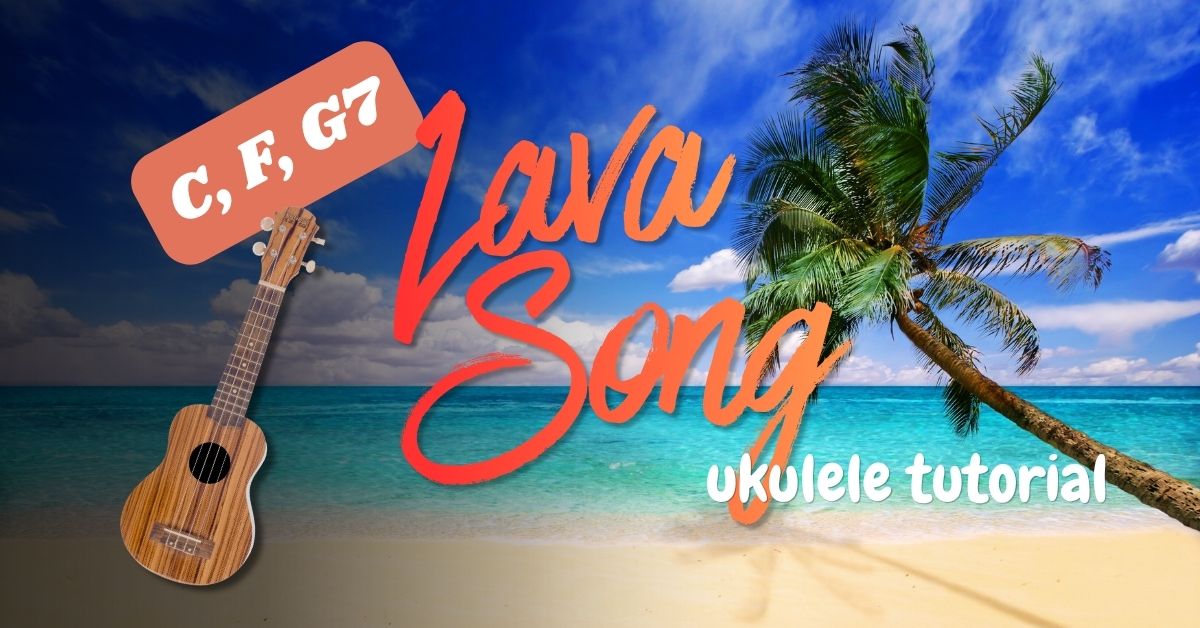
The “Lava” song is one of the most rewarding tracks you can learn as a ukulele beginner. Why? Because the entire song repeats the same three simple chords (C, F, G7), allowing you to focus on your rhythm rather than memorizing a complex structure.
In this guide, I’ll cover:
- The 4 essential chords you need.
- Visual guides for the strumming pattern.
- A “Pro Tip” for mastering the difficult F to G7 transition.
Let’s get those fingers moving.
Download our free practice resource here >
Lava Song Strumming Pattern Options
Beginners-Intermediate
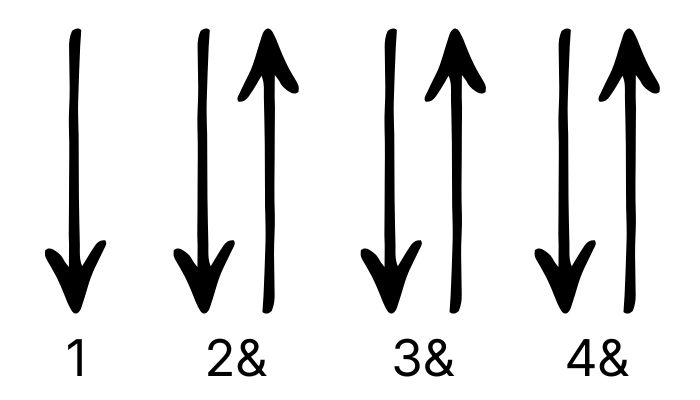
So, how this song is strummed is pretty simple. I’m not going to be playing any chords at first. We’re just going to strum the strings as they are – open. The first strumming pattern goes like this:
It goes down, down-up, down-up, down-up, down, down-up, down-up, down-up. If you were to count that, it would be: 1, 2, and 3 and 4 and 1, 2, and 3 and 4 and (1).
When strumming, I’m using my pointer fingernail on the strings on the down stroke. When I work my back way up, I’m playing with the skin of my pointer finger. So this means the down strokes will be more accented.
For Absolute Beginners
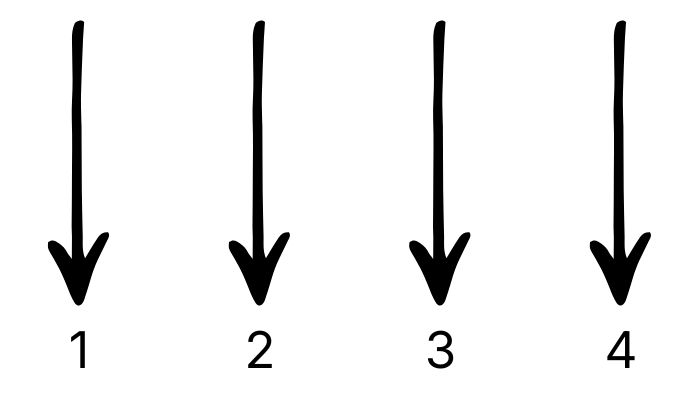
Now, if you’re an absolute beginner on the ukulele, I would go back and play a simpler pattern – just four down strums or 1, 2, 3, 4, 1, 2, 3, 4.
What Chords Are Used in the Lava Song?
The great part about this song is that there are really only three or four chords that you’re going to need to know how to play.
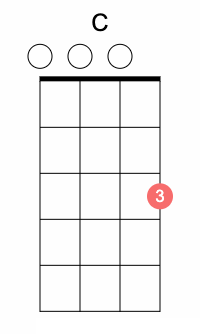
C Major Chord
For the first chord, the C chord, you’re going to play the third fret of the first string.

Note: My ukulele is using re-entrant tuning. That just means that my first note under my nose is ‘g’ and then it drops to ‘C, E, A’. You might have a low ‘G’ ukulele and that’s totally fine too! This is just going to sound a little bit more Hawaiian in my opinion of how the ukulele would sound.
G7 Chord
So, we had a C chord. The next chord you’re going to see in the song is going to be a G7 chord and it looks a little bit like this:
I’d use your pointer finger on the first fret of the second string (sometimes, people call this the easy F chord). Then, we’re going to surround that finger with two other fingers.
We’ve got the middle finger on fret two of the third string and then the ring finger also on fret two but on the first string. This creates this triangular shape on the neck.
F Major Chord
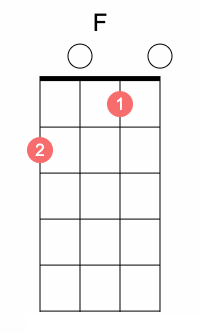
Our very next chord that we’re going to play in this song is an F chord. Here’s how it should look.
Take your middle finger and place it on fret two of the G string. The next string will be open, then the next string will be on fret one like it was on the G7 chord. Finally, the last string will be open as well.
Pro tip: How to change from F chord to G7 chord
Both the F chord and the G7 chord share one exact note: the Index Finger on the E string (1st fret).
The Trick:
- Play your F Chord.
- When it’s time to switch, DO NOT lift your index finger. Imagine it is super-glued to the fretboard.
- Simply pivot your hand slightly and drop your Middle and Ring fingers around it to form the G7 triangle.
Why this works: Your index finger acts as an “anchor.” By keeping it down, you stabilize your hand, cut the movement in half, and never lose your place on the fretboard.
C7 Chord
There is one more chord to learn and that’s the C7 chord. It’s played on the very first fret, first string. It’s the very first chord that I always teach students, since it’s a pretty easy one. You’ll see that sometimes right before we go to an F chord in the song.
Does the Lava Song Change Speeds?
Something unique about ‘Lava’ – that I think is really cool – is that the speed of the song changes based on what’s happening in the story.
This story is about a volcano that is sad and lonely, but when it meets another volcano it gets really excited. The song will slow down and speed up to reflect the emotions of the volcano in the song.
So, as you’re listening, keep that in mind. Don’t worry, I’ll try to give you tips as to when to change. If you do want to slow down with the original song, that’s going to happen at the first interlude [7:07] after we first hear the chorus “will send me someone to Lava”.
In the original song you’ll hear an explosion [8:53], and that’s the rising volcano out of the water. It starts a little fast, and then, it actually slows down about halfway through. We play the chorus again and then, we have another explosion at interlude 3 [10:13]. The fastest part of the tune is going to be verse four [10:16] and that’s how we’ll end the song.
‘Lava’ Song Sheet
Lava
Frequently Asked Questions (FAQ)
What are the main chords for the Lava song on ukulele?
The Lava song uses 4 simple chords: C, G7, F, and C7. The entire song repeats this friendly, predictable chord progression.
Is the Lava song easy for absolute beginners?
Yes! Lava is considered one of the ultimate beginner ukulele songs. It uses standard beginner shapes and allows you to start with simple 4-down-strums before learning the Island Strum.
What key is the Lava song played in?
This version is played in the Key of C Major. It can be played on Soprano, Concert, or Tenor ukuleles tuned to standard G-C-E-A tuning.
Wrapping Up
So there you have it! I hope you have as much fun learning to play ‘Lava’ as I did. Leave a comment below to let us know what you think of this lesson, and if there are any other ukulele songs you’d be keen to hear us cover.
Thanks so much for joining us and as always… Happy strumming!
Download our free practice resource here >

John Allnutt
Writer & Ukulele TeacherJohn has been teaching music since 2008 and resides in Richmond, Kentucky with his wife Laura and dog Sam. In his spare time he enjoys growing and cooking food, roasting coffee, playing board games, and spreading joy through playing and teaching music.